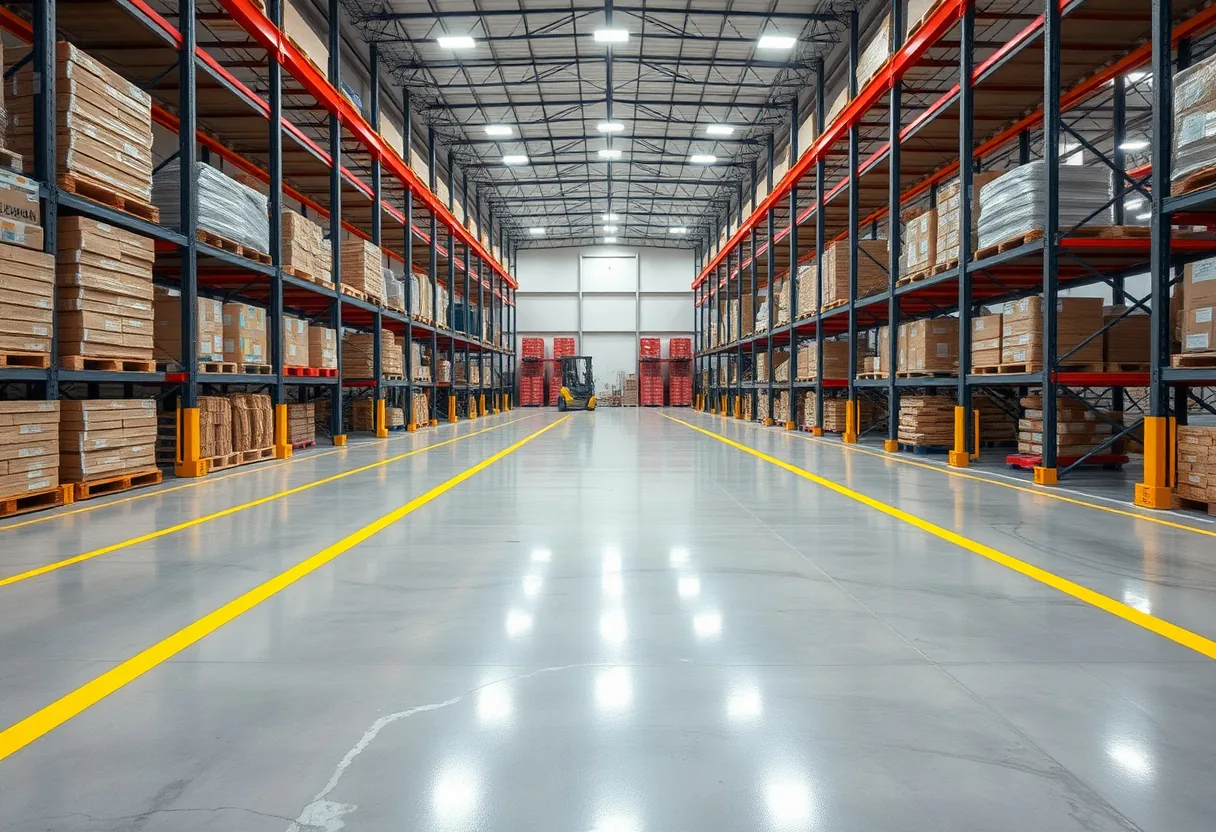
Floor Systems for High-Traffic Commercial & Warehouse Concrete
A warehouse slab takes more abuse in a month than a garage floor sees in a decade. We build layered systems that match the traffic: a high-build epoxy base coat for thickness and impact strength, finished with a polyaspartic topcoat that shrugs off abrasion, UV, and chemicals. The base fills and armors the concrete; the topcoat is the wear surface that actually meets the forklift tire.
From there we spec to the room. Quartz-broadcast systems trowel a bed of colored quartz into the base for a rugged, slip-resistant texture that hides wear. Solid-color builds give retail and showroom spaces a clean, seamless look. Static-control (ESD) systems dissipate charge in electronics, battery, and packaging areas where a spark is a real hazard. Every layout gets line striping and safety markings — forklift lanes, pedestrian walkways, staging grids, and OSHA-style hazard marking — baked into the coating instead of painted on top to peel away.
- High-build epoxy base — thick, impact-tough foundation that levels minor slab imperfections
- Polyaspartic topcoat — the abrasion, chemical, and UV-resistant wear layer that does the real work
- Quartz-broadcast — heavy-duty texture and slip resistance for wet or high-traffic zones
- Solid-color and metallic — seamless, easy-to-clean finishes for retail, showrooms, and breweries
- Static-control (ESD) — charge dissipation for electronics, packaging, and battery rooms
- Integrated line striping — lanes and safety markings sealed into the system, not layered on top
What a Commercial Floor Has to Survive
The reason cheap floor paint fails in a warehouse is simple: it was never built for the load. Your floor absorbs forklift traffic and pallet-jack wheels grinding the same lanes all day, point loads from loaded racking and staged pallets, dropped tools and parts, and a steady diet of hydraulic oil, degreasers, battery acid, and cleaning chemicals. Bare or sealed concrete dusts, stains, and pits under that. A thin one-coat epoxy chips at the edges within a season.
Polyaspartic topcoats are the answer to all of it in one layer. They are harder and more abrasion-resistant than standard epoxy, they resist the chemicals and oils that eat other coatings, and they are non-porous — nothing soaks in, so spills wipe up and the floor stays sanitary. That non-porous surface is also why these floors clean with a mop and an auto-scrubber instead of a pressure washer and a prayer.
Why forklift floors fail early
Nine times out of ten it is not the coating — it is the prep. A coating laid over a smooth, moisture-loaded, or contaminated slab has nothing to grip, so forklift torque peels it in the drive lanes first. We diamond-grind to a proper profile and moisture-test before a single gallon opens. Get the bond right and the system outlives the equipment rolling on it.
Businesses We Coat Across Louisiana
If concrete has to take a beating and still look professional, it is a candidate for a coated system. We install for a wide range of commercial and industrial operations, and we tune the buildup and texture to how each space actually gets used.
- Warehouses and distribution centers — high-build systems rated for constant forklift and pallet-jack traffic
- Retail and showrooms — bright, seamless, easy-to-maintain solid-color and metallic finishes
- Auto and truck shops — chemical- and oil-resistant floors that clean up after every job
- Breweries and food-adjacent spaces — sanitary, non-porous surfaces with slip-resistant texture
- Gyms and fitness facilities — durable, impact-tough coatings that take dropped weights
- Aircraft hangars — large-area systems with fuel and hydraulic-fluid resistance
For the heaviest-duty and wash-down environments — commercial kitchens, processing plants, and USDA-adjacent spaces — step up to our industrial & food-processing floors, which add cove base, thicker mortar systems, and antimicrobial options.
The Louisiana Slab Problem — and How We Beat It
Louisiana is the reason so many commercial coatings peel. High humidity and elevated slab moisture push vapor up through the concrete, and when that vapor hits the underside of a coating with no path out, it breaks the bond — the floor delaminates, bubbles, and lifts in sheets. A coating installer who skips moisture testing is setting your floor up to fail, and it usually fails right after the warranty conversation gets awkward.
We do it the right way. Every commercial job starts with diamond grinding to open the concrete to a clean, bondable profile, followed by moisture testing to measure exactly what the slab is giving off. If the numbers are high, we install a moisture mitigation primer that seals the vapor before we build the system — so the coating bonds to concrete engineered to hold it, not to hope.
The other Louisiana advantage is speed. Polyaspartic cures fast, even in our humidity, which means a bay can be ground, coated, and back under forklift traffic in as little as a day. We run weekend and after-hours installs and phase the work bay by bay, so your operation keeps shipping while the floor goes down. Downtime is the real cost of a floor project, and fast cure is how we cut it to near zero.
Durability, Safety, and Return on Investment
A coated floor is not a cosmetic upgrade — it pays for itself. A sealed, non-porous surface stops concrete dust from settling on inventory and equipment, cuts cleaning labor, and eliminates the constant re-sealing and patching a bare slab demands. A properly installed system runs 15 years or more under commercial traffic, so the cost spreads across a decade-plus of service instead of a repaint every couple of years.
Safety is engineered in, not added on. We tune slip resistance to the environment with broadcast aggregate — aggressive texture in wet and wash-down zones, smoother finishes where carts and pallet jacks need to roll easy. Bright, reflective topcoats push more light around the space, and sealed-in lane striping and hazard markings keep forklift and foot traffic separated. For occupied facilities, we phase the install section by section so no area goes fully offline.
| System | Traffic rating | Cost | Downtime | Best use |
|---|---|---|---|---|
| High-build epoxy | Heavy | $ | 2-4 days full cure | Warehouse base coat, budget-driven large areas |
| Polyaspartic topcoat | Very heavy | $$ | 1 day, reopen overnight | Wear layer, fast-turnaround bays, occupied facilities |
| Quartz-broadcast | Very heavy | $$$ | 2-3 days | Wet zones, breweries, maximum slip resistance and texture |
What a Commercial Floor Coating Costs
Commercial pricing is driven by square footage, the condition of your existing slab, the system you choose, and how much repair or moisture mitigation the concrete needs before coating. As a planning range, most Louisiana commercial systems land between $4 and $9 per square foot installed — a straightforward solid-color epoxy-plus-polyaspartic build sits at the low end, while heavy quartz-broadcast and ESD systems run higher.
Volume pricing works in your favor. Mobilization, grinding, and setup are fixed costs, so the per-foot number drops as the area grows — a 20,000 sq ft distribution floor prices far better per foot than a single 1,500 sq ft bay. Slab repair, crack and joint repair, and moisture mitigation are quoted separately once we have tested the concrete, so you see exactly what you are paying for.
Every commercial system comes with a written warranty on adhesion and workmanship, and our fast-cure polyaspartic 1-day systems mean you are rarely paying for extended downtime on top of the floor. Want a real number for your building? Get a free quote or call 844-967-5247 and we will measure, test, and spec the right system for how you actually use the space.