Floor Coating FAQ
22 real questions from Louisiana homeowners and businesses — cost, humidity, 1-day install, polyurea vs epoxy, and how long these floors really last.
/ Cost & Value
A professional flake polyaspartic/polyurea floor typically runs about $5-$12 per square foot installed, so a standard two-car garage (roughly 400-500 sq ft) often lands around $2,500-$6,000. Solid-color epoxy is cheaper up front but less durable in our humidity. Size, concrete condition, and system drive the price — see our cost guide.
Almost always. DIY epoxy kits run $1-$2 per square foot but frequently peel on humid, flood-prone Louisiana slabs within a year or two, so you pay again to redo it. A properly prepped polyaspartic system costs more once and lasts decades — the lower lifetime cost is the real value.
Yes. We offer financing so a new floor fits your budget, which is popular for larger garages, patios, and whole-home projects. Ask about options when you request your free quote and we will walk you through monthly payment plans alongside your written estimate.
Yes. We come measure your space, inspect and moisture-test the concrete, and give you a written estimate at no cost and no obligation. Because Louisiana slabs vary so much in moisture and condition, an on-site look is the only way to quote a floor accurately — an online guess would not be honest.
With proper diamond-grinding prep and the right system for your slab, these floors commonly last 15-20+ years, and many carry a 15-year to lifetime warranty. Polyaspartic topcoats are UV-stable and abrasion-resistant, so they hold their finish far longer than epoxy — especially outdoors and in hot Louisiana garages.
/ Louisiana Humidity & Moisture
Yes — if it is installed correctly. Humidity and a high water table push moisture up through concrete, which is the number-one reason cheap coatings peel here. We diamond-grind, moisture-test the slab, and add moisture mitigation when needed so the coating bonds and stays down. Polyaspartic also cures reliably in humidity where epoxy struggles.
Two reasons: bad prep and moisture. Acid-etching instead of grinding leaves a weak bond, and Louisiana's high slab moisture (from humidity, the water table, and flooding) pushes up under the coating and delaminates it. We solve both with mechanical diamond grinding, moisture testing, and vapor-mitigation primers on wet slabs. See our humidity guide.
Yes. We test the slab's moisture level and, if it is high, install a moisture-mitigation primer so the coating still bonds with a warranty. A finished polyurea floor is seamless and non-porous, which actually makes flood cleanup easier — water and mud rinse off instead of soaking into bare concrete and leaving stains and mildew.
Always, here in Louisiana. We use calcium-chloride and/or relative-humidity probe testing to measure how much moisture your slab is giving off before we choose a system. It is the step most cut-rate installers skip, and skipping it is exactly why their floors fail. Testing lets us guarantee the bond.
/ Materials & Durability
Epoxy is a rigid, lower-cost build coat that can yellow and is moisture-sensitive. Polyurea is a fast, flexible, extremely tough coating. Polyaspartic is a UV-stable type of polyurea used as a fast-curing topcoat and 1-day system. We often use an epoxy or polyaspartic base with a polyaspartic topcoat. Our buyer guide breaks it all down.
Yes. Polyurea and polyaspartic coatings are roughly four times more abrasion-resistant than standard epoxy, stay flexible so they move with the slab instead of cracking, resist hot-tire pickup, and shrug off chemicals and stains. Epoxy still has its place as a thick base coat, but as a topcoat polyurea wins on durability — see polyaspartic systems.
Not with a polyaspartic topcoat. Standard epoxy ambers and yellows under UV, which is a real problem on Louisiana patios, pool decks, and sunny garages. Polyaspartic is UV-stable and keeps its color and gloss for years, which is why we top nearly every floor — including metallic and flake finishes — with it.
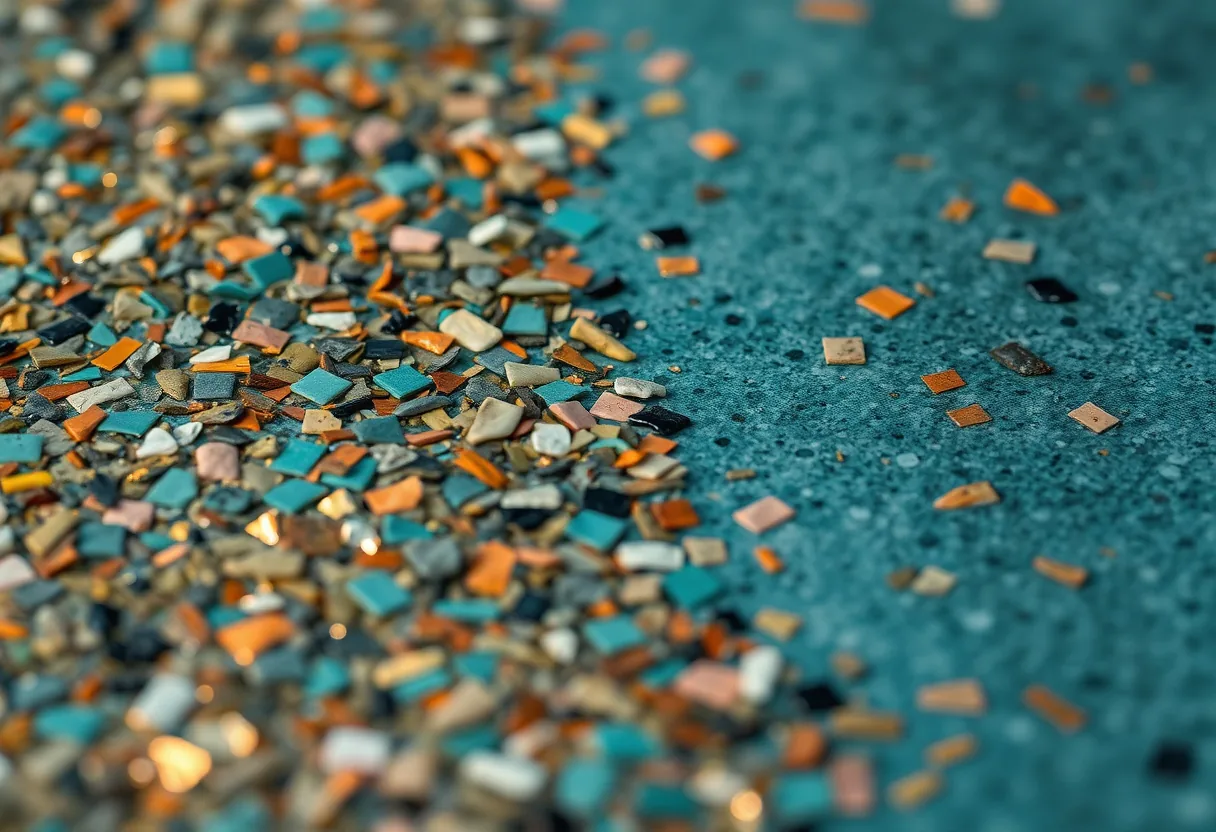
It doesn't have to be. We broadcast vinyl flakes and can add anti-slip aggregate to the topcoat to create texture, which is important for pool decks and patios and wet commercial areas. We match the slip-resistance level to how the space is used, so it stays safe underfoot even in Louisiana rain.
Yes. Polyurea and polyaspartic resist hot-tire pickup — the peeling you get when hot tires lift a weaker coating — and they stand up to oil, gas, brake fluid, pool chemicals, and household cleaners. For heavy industrial chemical exposure we spec novolac or urethane systems rated for it.
/ Process & 1-Day Install
For most residential floors, yes. Polyaspartic cures fast even in Louisiana humidity, so we grind, repair, basecoat, broadcast flakes, and topcoat all in a single day. You can usually walk on it that evening and drive on it in about 24 hours. Major concrete repair or moisture mitigation can add time — see our 1-day install guide.
With a polyaspartic system, you can typically walk on the floor within a few hours of the final coat and park vehicles on it after about 24 hours. We give you exact times for your specific system and the day's conditions before we leave, so you don't rush it and mar a fresh finish.
Just clear the space — move vehicles, storage, and anything on the floor before we arrive. We handle the rest: grinding dust is controlled with vacuum-shrouded equipment, we mask surrounding surfaces, and we clean up fully. For businesses we schedule around your hours, including nights and weekends, to avoid downtime.
We mechanically diamond-grind (or shot-blast) the concrete to open the surface to a proper bonding profile — never a quick acid etch, which is a common shortcut that leads to peeling. Then we repair cracks, joints, and spalling and test moisture. Prep is 80% of a coating that lasts, and it is where we do not cut corners.
/ Service Area & Projects
We serve Louisiana statewide, including New Orleans, Baton Rouge, Lafayette, Shreveport, Lake Charles, Metairie, Bossier City, Houma, Slidell, and Covington. See our service areas page, or just call — if your project is in Louisiana, we can most likely help.
Yes. Beyond garages, we install commercial and warehouse floors and heavy-duty industrial and food-processing systems — urethane mortar, quartz, antimicrobial and chemical-resistant coatings — with phased installs to keep your operation running.
Absolutely. Textured, UV-stable, slip-resistant coatings are ideal for Louisiana patios and pool decks, and non-porous systems resist the mildew and staining that bare outdoor concrete gets in our humidity. Interior slabs, sunrooms, and basements work great too.
Request a free quote through our online form or call 844-967-5247. Tell us the space, approximate size, current concrete condition, and your city, and a Louisiana coating specialist will reach out to schedule your free on-site measurement — usually within one business day.
Question We Didn't Cover?
Call 844-967-5247 and ask a Louisiana coating specialist directly — or request a free quote and ask when we come measure.