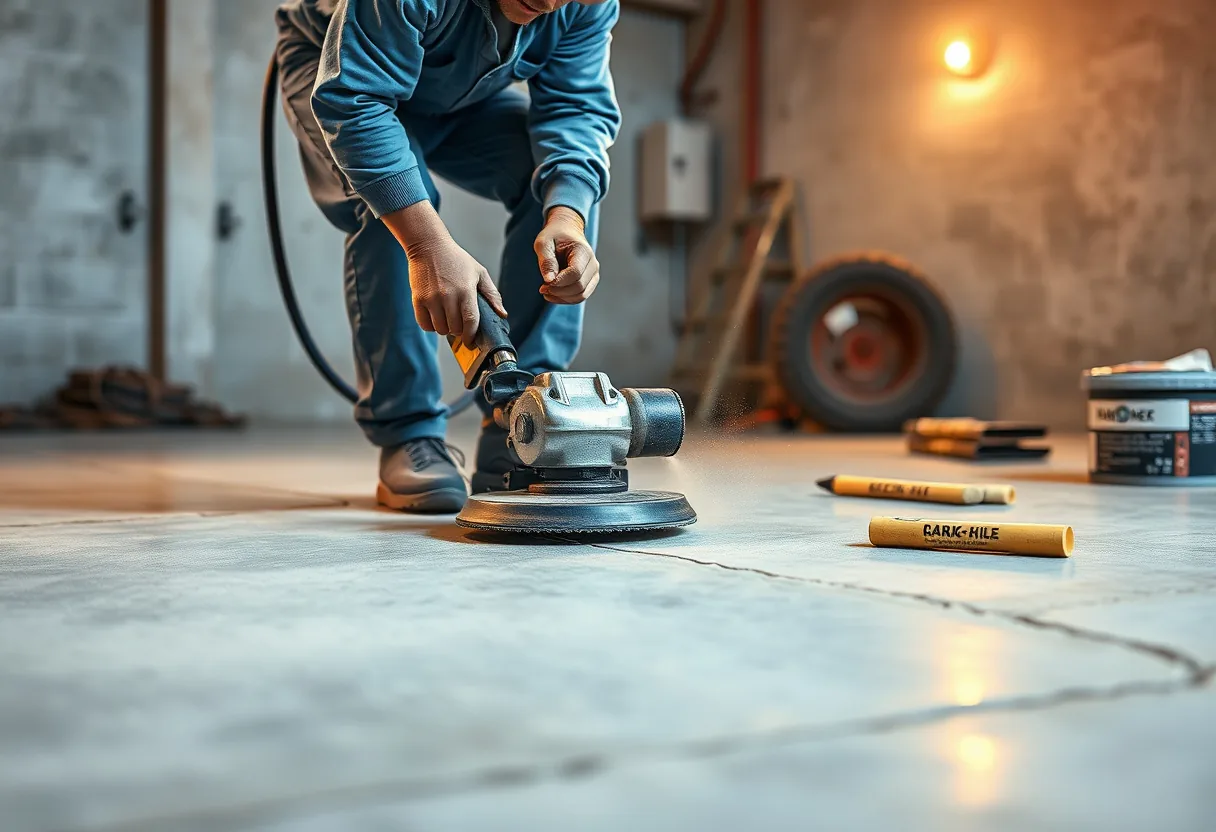
Why Louisiana Slabs Peel Coatings From the Bottom Up
Almost every failed garage or shop floor we are called to fix in Louisiana failed for the same reason: moisture vapor coming up through the concrete. It is not a bad batch of epoxy and it is not the installer's roller technique. It is the ground under the slab.
Louisiana sits on a high water table, heavy annual rainfall, and soils that hold water like a sponge. That groundwater does not stay put — it evaporates up through the pores of your concrete as moisture vapor transmission (MVT). A slab that looks bone-dry to your hand can be pushing several pounds of water vapor per 1,000 square feet every day, and running an internal relative humidity (RH) north of 90 percent.
When a coating is bonded to the top of that slab, the rising vapor has nowhere to go. Pressure builds under the film until it lets go — you get bubbling, blistering, and delamination, and the coating peels off in sheets. This is the single biggest reason a cheap one-day garage coating fails in this state, usually within a year or two.
Why the bargain coating peeled
A crew that grinds nothing, tests nothing, and rolls a big-box epoxy over a damp Louisiana slab is selling you a countdown, not a floor. The coating did not fail because it was cheap material — it failed because nobody measured the moisture underneath it. That step is exactly what this service exists to do.
We Test Moisture Before We Coat — Every Time
You cannot see vapor pressure, so we measure it. Before any coating touches your slab, we run industry-standard moisture testing and let the numbers pick the system — not the other way around.
- Calcium chloride test (ASTM F1869) — a sealed dish weighs how much moisture the slab gives off over 60-72 hours, reported as pounds of vapor emission per 1,000 sq ft per day. It tells us what is coming off the surface right now.
- In-situ relative humidity probe (ASTM F2170) — a sensor set into a drilled hole reads the RH deep inside the slab, where the moisture actually lives. It tells us what the slab will do once a coating traps it.
- Plastic-sheet and pH checks — quick field reads for surface dampness and alkalinity that would attack the wrong primer.
In Louisiana we assume a slab is wet until it proves otherwise. Testing costs a fraction of a redo, and it is the difference between a warranty we can actually stand behind and a hopeful guess. If the numbers come back high — and near the coast, they usually do — we do not walk away. We mitigate.
Moisture Mitigation: Coating High-Moisture Slabs With a Warranty
A high moisture reading is not a dead end. It just means the slab needs a moisture-mitigation layer before the finish coat. This is the technology that lets us warranty floors that a big-box kit could never survive on.
We install a 100 percent solids epoxy vapor-block primer — a dense, penetrating barrier engineered to knock a slab down from double-digit vapor emissions to a level the finish system can tolerate. Top-tier vapor-block systems are rated to hold back very high RH and emission numbers, so even a coastal slab that reads off the chart gets a stable, bonded foundation. The polyurea or epoxy topcoat then goes down over a surface that behaves like a proper dry slab.
This is the layer the discount crews skip to hit a price, and it is the layer that makes a Louisiana floor last. It pairs with everything we install — read more in our humidity guide.
Concrete Repair: Fixing the Slab Before We Coat It
A coating is only as good as the concrete under it. A perfect finish over a cracked, pitted, or contaminated slab just telegraphs every flaw and fails at the weak point. So repair comes first.
- Crack and control-joint repair — we chase out cracks, fill them with a rigid polymer that bonds and cures harder than the slab, and honor or fill control joints so movement does not tear the finish.
- Spall and pit patching — flaked, popped, and low spots get cleaned and rebuilt with a patching mortar keyed to the coating, so the surface is flat and sound.
- Grinding down high spots — trowel ridges and heaves are ground flush so the floor reads level and the coating lays even.
- Rust, oil, and stain remediation — years of soaked-in motor oil, hydraulic fluid, and rust are degreased and pulled from the pores; a coating will not bond over contamination.
- Re-profiling — after repairs, the whole floor is opened back up to a uniform texture so the new system grips edge to edge.
Done right, the repair work disappears under the finish and the whole floor moves as one sound surface. Done never, it is the crack that reappears through your brand-new coating by next summer.
Surface Prep Done Right: Grinding and Shot Blasting, Never Acid
Adhesion is not about the paint — it is about the profile. A coating grips concrete the way tape grips a scuffed surface, and creating that mechanical tooth is the real craft of this trade.
We open the slab with diamond grinding and, on larger or rougher floors, shot blasting — mechanical prep that removes the weak surface layer and leaves a measurable Concrete Surface Profile (CSP), typically CSP 2-3 for our systems. That texture is what the vapor-block primer bites into.
What we never do is acid etching. Acid is what a big-box weekend kit tells you to use because it comes in a jug, but it does not cut a real profile, it drives moisture and salts back into the slab, and it leaves residue that sabotages adhesion. On a wet Louisiana slab, etching is one of the surest ways to guarantee a peel. Mechanical prep is not optional here — it is the whole game.
Flood Recovery: Re-Prepping and Re-Coating After Water
Louisiana floods, and floors take the hit. After water sits on a slab — or worse, backs up under a coating — the fix is not a mop and a prayer. We re-prep the floor: strip failed coating, grind the slab back to sound concrete, re-test moisture (a flooded slab reads high for weeks), mitigate, and re-coat.
The upside of doing it right is what happens the next time water comes in. A properly installed polyurea or epoxy system is non-porous — floodwater sits on top of it instead of soaking into the concrete. When the water recedes you squeegee, rinse, and disinfect a sealed surface instead of fighting mud, stink, and mildew ground into bare pores. In a flood-prone parish, that is a floor that pays you back.
Problem to Fix: What This Service Actually Solves
Most of what goes wrong with a Louisiana floor traces back to one of a handful of slab conditions. Here is what we look for and how we handle each one before a single coat goes down.
| The problem | What's really happening | Our fix |
|---|---|---|
| Coating peeling or bubbling | Moisture vapor pushing up through the slab (MVT) | Calcium chloride + RH testing, then an epoxy vapor-block primer |
| Cracks and open joints | Slab movement and shrinkage telegraphing through the finish | Rout and fill with rigid polymer; honor control joints |
| Constant dampness or RH over 90% | High water table wicking groundwater into the concrete | Full moisture-mitigation system before coating |
| Spalling, pitting, flaking | Surface concrete weak, popped, or contaminated | Patch with keyed mortar, grind flat, re-profile |
| Oil and rust stains | Contaminants soaked into the pores blocking adhesion | Degrease, remediate, and mechanically open the surface |
What Prep Costs — and Why It Protects the Whole Floor
Prep is the part of a floor you never see and can never skip. Basic grinding and repair are built into every coating we quote. Moisture mitigation is the variable: when testing calls for a vapor-block system, budget roughly $1.50-$3.00 per square foot on top of the coating, depending on how high the slab reads and how much repair it needs. Numbers are estimates — the moisture test sets the real figure.
That add-on feels like the optional line item. It is the opposite. It is the layer that protects the entire system and the warranty — the finish coat, the labor, and your weekend. Skip it to save a dollar a foot and you are not buying a cheaper floor, you are buying the same peel the last crew sold. Every floor we install rides on this prep: our garage floor coating, our commercial & warehouse floors, and our epoxy floor coatings.
Want to know what your slab actually needs? We will test it and tell you straight. Get a free quote or call 844-967-5247 and we will get a moisture reading before anyone quotes you a coating.