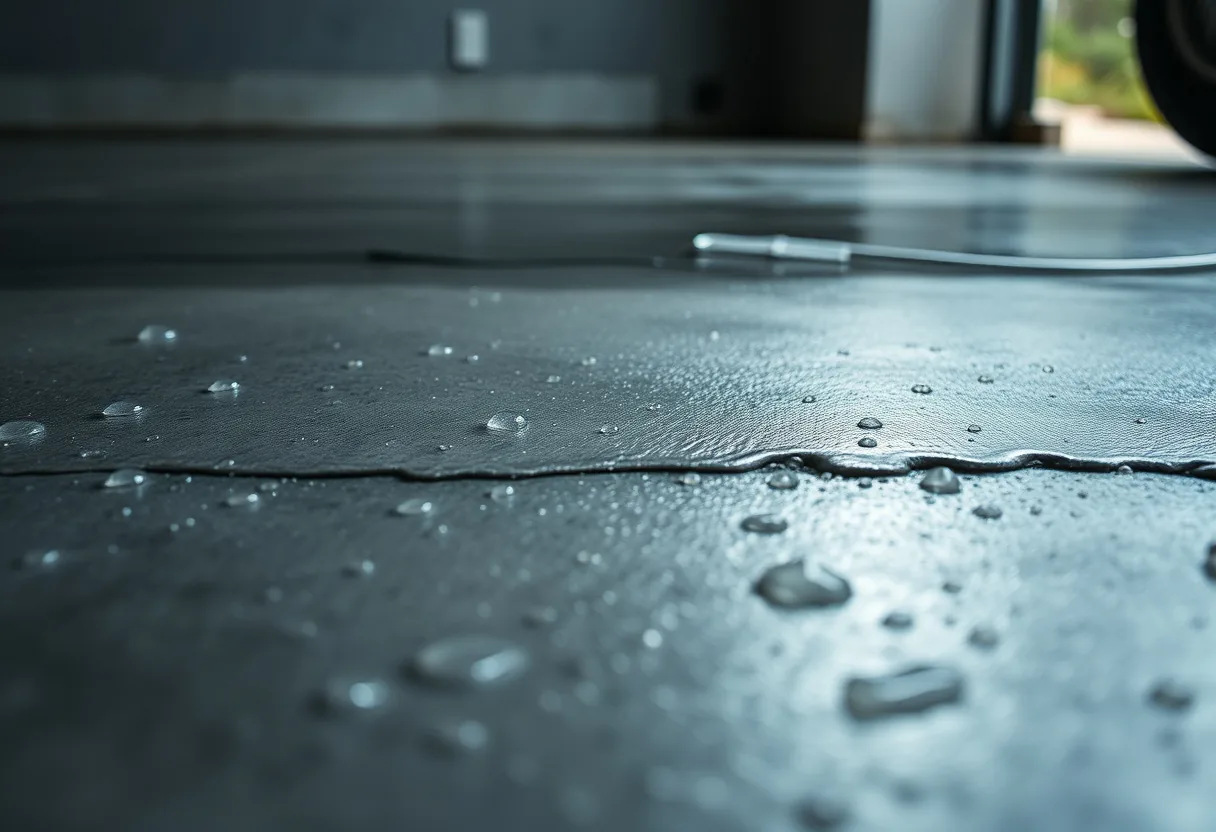
Why Louisiana Is Uniquely Hard on Floor Coatings
Nowhere in the country tests a garage floor coating like South Louisiana. We sit on a high water table, wrapped in subtropical humidity, hammered by heavy rain, and dotted with flood-prone slabs that were poured barely above grade. Every one of those conditions has the same effect on your concrete: it keeps the slab full of water.
Concrete is not the sealed stone most people assume — it is a porous sponge. When the ground beneath a Baton Rouge or Lafayette slab stays saturated, water wicks upward and evaporates off the surface as moisture vapor transmission, a constant upward push of humidity through the pores. Pour a slab on wet Gulf Coast ground and its internal relative humidity can sit near 100 percent for the life of the home. A properly installed coating lives with that vapor. A cheap one gets destroyed by it.
How Trapped Moisture Destroys a Bad Coating
When vapor rises through the slab and hits a film that cannot breathe or was never bonded properly, it has nowhere to go. Pressure builds under the coating until it lifts. That is the mechanism behind almost every floor-coating failure we are called in to fix across Louisiana.
- Bubbling and blistering — vapor collects in pockets and pushes the film up into raised domes
- Delamination and peeling — the bond lets go and whole sheets flake off, usually starting at edges and cracks
- White haze and efflorescence — dissolved slab minerals ride the moisture up and deposit under or through the film
- Mildew and staining — damp, porous concrete under a failed coating becomes a home for mold
This is the number one reason cheap DIY epoxy fails in Louisiana. The big-box kit goes down beautifully on a Saturday, then two humid summers later it is peeling in sheets — because the product and prep never accounted for a slab that sweats from below.
Why Polyaspartic and Polyurea Handle Humidity Better
Not all coatings react to Louisiana moisture the same way. Polyaspartic and polyurea systems are simply built for this climate in ways traditional epoxy is not.
- Reliable cure in high humidity — polyaspartic cures fast and consistently even in muggy Gulf air, while many epoxies cloud, soften, or refuse to fully harden
- Flexibility and vapor tolerance — the film flexes with the slab and handles vapor movement instead of cracking and blistering under it
- The right primer for the slab — we pair the topcoat with a primer matched to your slab's real moisture level, which is where the bond is won or lost
That is why we build every floor around a polyaspartic 1-day system rather than a hardware-store epoxy — it is engineered for the exact conditions that make our region punishing.
The Prep That Actually Prevents Failure
The best coating in the world will still peel if the concrete underneath was not prepared and tested. In Louisiana, prep is not the boring part of the job — it is the part that decides whether your floor lasts one year or twenty.
- Diamond grinding, not acid etch — we mechanically grind the surface open so the coating bites into the concrete; acid etching leaves a weak, residue-laden profile that fails under vapor pressure
- Calcium chloride and RH probe testing — before we coat, we measure how much moisture your slab is actually releasing, so nothing is left to guesswork
- Moisture-mitigation primers and vapor barriers — on high-moisture slabs we install a moisture-mitigation layer that holds vapor back and gives the finish coats a dry, stable base to bond to
Ask this one question before you hire anyone
Before signing, ask an installer how they will test the slab's moisture. If the answer is not a calcium chloride test or an in-slab RH probe, keep looking. Skipping the moisture test is exactly how a coating that looks flawless on day one delaminates by next summer. In Louisiana, testing is not optional.
Flooding: The Louisiana Factor Nobody Plans For
Coating a flood-prone garage is not just about looks — it is about recovery. When water gets into bare concrete, it soaks in, carries stains deep, and leaves mildew behind long after the water recedes.
A non-porous polyaspartic surface changes the equation. Floodwater sits on top of the film instead of soaking in. Once it drains, you squeegee and hose the floor clean — no absorbed stains, far less mildew, and none of the permanent discoloration that ruins bare slabs. For low-lying parishes, that resilience is one of the strongest reasons to coat.
Symptom, Cause & Fix at a Glance
If you already have a failing floor, the symptom usually points straight to the cause. Here is how the most common Louisiana failures break down.
| Symptom | Likely Cause | The Fix |
|---|---|---|
| Bubbles and blisters | Moisture vapor pushing up through a non-breathable film | Grind off, moisture-test, install a mitigation primer, recoat |
| Peeling edges and flaking sheets | Weak bond from acid etch or a skipped grind | Full diamond grind to bare concrete, then a bonded system |
| White haze or chalky film | Efflorescence — slab minerals carried up by moisture | Test moisture, mitigate the slab, apply a vapor-tolerant coat |
| Mildew and dark staining | Damp, porous concrete feeding mold under a failed coat | Remediate, dry and test the slab, seal with a non-porous finish |
How to Make Sure Your Floor Actually Lasts
Choosing an installer here comes down to two things: do they test moisture, and do they stand behind the bond?
- They moisture-test every slab — calcium chloride or RH probe, before any coating goes down
- They grind, they don't etch — mechanical profiling is non-negotiable for a lasting bond
- They warranty the bond — a real adhesion warranty means the installer is confident the floor will not peel
That is exactly how we approach every garage floor coating we install. If you want to weigh systems and pricing first, our cost guide breaks down polyurea versus epoxy for our climate. When you are ready, get a free quote or call 844-967-5247 for an estimate on your slab.
Frequently Asked Questions
Yes, when it is the right system installed correctly. Polyaspartic and polyurea coatings cure reliably in high humidity and tolerate the moisture vapor rising through Louisiana slabs. The failures you see are almost always cheap epoxy over untested, poorly prepped concrete — not a limit of coatings themselves.
Almost always trapped moisture. Louisiana's high water table pushes vapor up through the slab, and if the concrete was acid-etched instead of ground and never moisture-tested, that vapor lifts the epoxy from underneath. It bubbles, then peels. The product and prep never accounted for a slab that sweats from below.
It is water vapor moving up through porous concrete as ground moisture evaporates off the surface. On saturated Gulf Coast ground, a slab's internal humidity can stay near 100 percent for years. That constant upward push is what blisters and delaminates a coating that cannot breathe or was never properly bonded.
We use two proven methods: a calcium chloride test that measures how much moisture the slab releases over time, and an in-slab RH probe that reads relative humidity inside the concrete. Those numbers tell us whether the slab needs a moisture-mitigation primer or vapor barrier before any finish coat goes down.
Absolutely, and it is one of the best reasons to coat. A non-porous polyaspartic surface keeps floodwater from soaking into the concrete, so after water recedes you can squeegee and hose the floor clean. You avoid the soaked-in stains and mildew that make bare slabs so hard to recover.
Yes. Because we diamond-grind, moisture-test, and mitigate high-moisture slabs before coating, we stand behind the bond with an adhesion warranty. Testing the slab first is what makes that protection possible. Call 844-967-5247 for an estimate and we will walk you through what your specific floor needs.