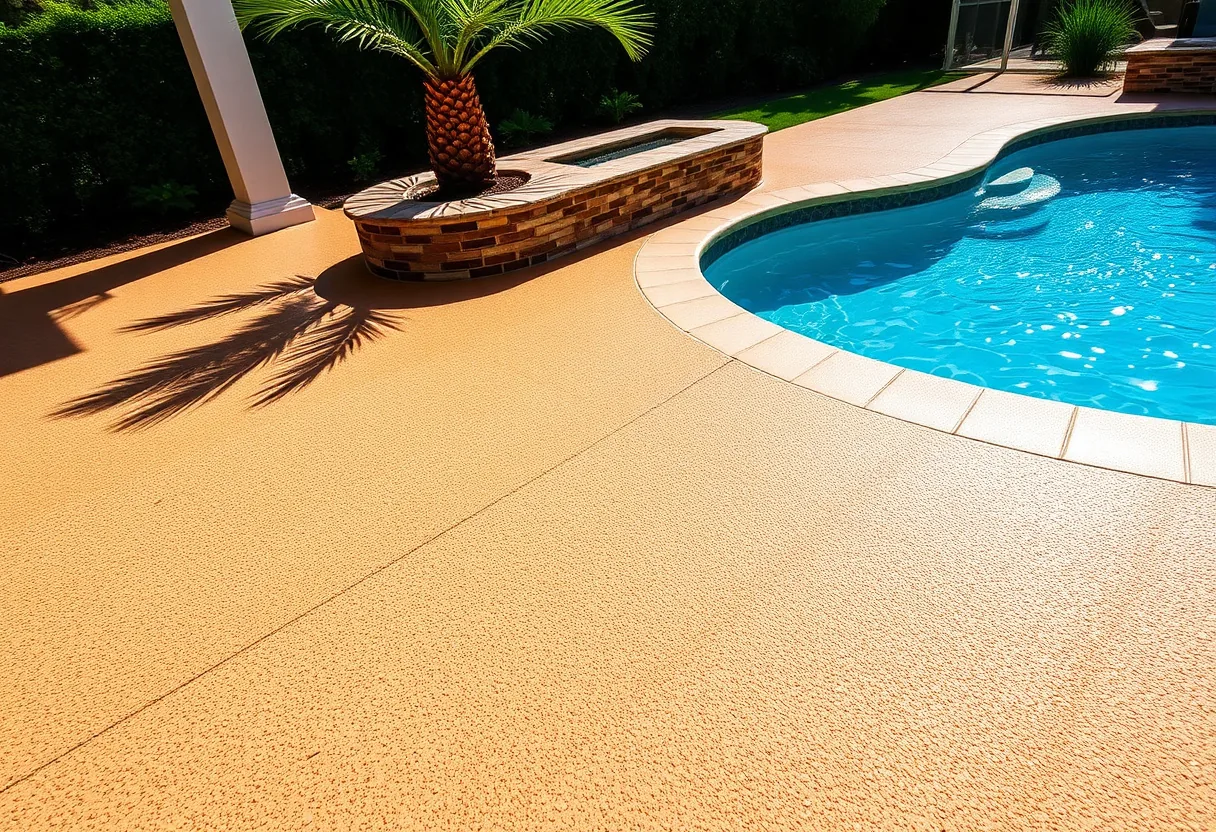
Outdoor Coating Systems Built for the Wet, Bright South
Not every floor coating belongs outdoors, and almost none belong around a pool. The systems we install on Louisiana patios and pool decks are engineered specifically for UV exposure, standing water, and bare feet — three conditions that break down the wrong product fast. The core of every outdoor build is a polyaspartic or polyurea system broadcast with a decorative flake (chip) layer for texture, then locked in with a textured, non-slip topcoat.
The flake broadcast does double duty: it hides surface imperfections in weathered concrete and it builds in grip. On pool decks and around outdoor showers we push the texture further with an aggregate additive in the final coat, giving you a slip-resistant surface that stays safe when it is soaking wet. And because a light-toned polyaspartic reflects heat instead of absorbing it, the finished deck runs noticeably cooler to the touch than dark stamped or plain gray concrete baking in the summer sun.
- Flake / chip broadcast — decorative texture that masks flaws and adds grip
- Textured non-slip topcoat — aggregate-loaded final coat, critical on wet pool decks
- UV-stable polyaspartic / polyurea — will not yellow or amber in the Louisiana sun
- Cool-to-the-touch color options — lighter tones reflect heat for bare feet
Why Polyaspartic Beats Stamped Concrete and Epoxy Outdoors
Stamped and plain concrete look fine the day they cure, then the Gulf climate goes to work. Concrete is porous, so it drinks in water and becomes a host for mildew, algae, and mold — the green-black film you scrub off your patio every spring. It also cracks as the slab moves through Louisiana's heat and humidity swings. Epoxy is a common upgrade, but standard epoxy is the wrong tool outside: it ambers and chalks under UV, turning that clean finish a dingy yellow within a season or two, and it is rigid enough to crack when the slab flexes.
Polyaspartic and polyurea solve both problems at once. They are UV-stable, so the color you pick is the color you keep — no yellowing, no ambering. They stay flexible, moving with the slab through heat and humidity instead of fracturing. And they cure into a seamless, non-porous membrane with nowhere for mildew or algae to take root, so the whole deck wipes clean and handles pool chemicals, chlorine, and salt without breaking down.
| Factor | Plain / Stamped Concrete | Standard Epoxy | Polyaspartic / Polyurea |
|---|---|---|---|
| UV stability | Fades and stains | Yellows and chalks | Holds color, no ambering |
| Porosity | Porous — hosts mildew | Semi-porous at wear points | Seamless and non-porous |
| Flexibility | Cracks as slab moves | Rigid — can crack | Flexes with the slab |
| Wet slip resistance | Slick when wet | Slick unless textured | Aggregate non-slip finish |
| Cure / return to use | Weeks to fully cure | 2-3 days between coats | Same-day walk-on |
Why UV stability is the whole game outdoors
The single biggest reason outdoor epoxy jobs disappoint is ambering — the yellow-brown shift that hits within a season of full sun. Polyaspartic and polyurea are chemically UV-stable, which is exactly why we specify them for every patio and pool deck. The finish you choose today is the finish you will still see in a decade.
The Louisiana Climate Case for a Coated Deck
Louisiana is close to a worst-case environment for bare and stamped concrete. You get brutal, near-year-round UV, some of the highest humidity in the country, frequent heavy rain, and low-lying, flood-prone patios that stay damp long after the storm passes. That combination is a greenhouse for mildew, algae, and mold, and it turns any slick surface into a genuine slip hazard the moment it rains.
This is precisely where a coated deck earns its keep. The non-porous membrane starves mildew and algae of the moisture they need, so you stop pressure-washing green off the concrete every few months. The aggregate non-slip texture keeps footing sure around a splashing pool or after a downpour. And because polyaspartic cures in hours, not days, we can get the pool area back in service the same weekend — a real advantage when the swim season is long and you do not want it fenced off.
Where These Coatings Go
If it is exposed concrete outside your home, it is a candidate. We coat the surfaces your family actually lives on through a Louisiana summer:
- Pool decks — the flagship application, where non-slip texture and chemical resistance matter most
- Patios — seamless, cleanable entertaining space that resists stains and mildew
- Porches — front and back, with color matched to the house
- Walkways — grippy, trip-free paths between the drive, door, and yard
- Outdoor kitchens — grease- and heat-tolerant surfaces that wipe down fast
- Sunrooms — a durable, low-glare floor that ties the indoor and outdoor space together
Many homeowners tie the pool deck together with a matching driveway or [garage floor coating](/services/garage-floor-coating/) so the whole property reads as one finished system rather than a patchwork of gray slabs.
Slip Resistance, Texture, and Color Design
The right amount of grip depends on where the surface lives. A shaded covered porch does not need the same aggressive texture as the wet apron right at the pool's edge, so we tune the topcoat to the spot. Here is how the common options compare:
| Texture Level | Best For | Feel Underfoot |
|---|---|---|
| Light / standard | Covered porches, sunrooms | Smooth, easy to sweep, gentle grip |
| Medium aggregate | Patios, walkways | Sure-footed, still comfortable barefoot |
| Heavy aggregate | Pool decks, steps, wet zones | Maximum wet-grip, sandal-friendly |
Color and design are just as flexible. Standard flake blends range from subtle earth tones to bright coastal palettes, and we lean toward lighter, heat-reflective colors on pool decks so the surface stays cool for bare feet. For a higher-end look, a [metallic flake finish](/services/metallic-flake-floors/) brings depth and movement — think a marbled, water-like shimmer that suits a pool deck beautifully. We will lay out physical samples on your actual slab so you can see the finish in Louisiana light before we start.
Surface Prep on Weathered Outdoor Slabs
A coating is only as good as the concrete beneath it, and outdoor slabs take a beating before we ever arrive. The prep stage is where a lasting deck is won or lost. We start by diamond-grinding or shot-blasting the surface to open the concrete's pores and give the coating a mechanical bite — no bonding shortcuts, no thin acid-etch that peels in a year.
Weathered patios and pool decks almost always need repair work first: spalling, cracks, chips, and low spots from years of freeze, sun, and settling. We fill and rebuild those before coating so the finish goes down flat and stays put. Because outdoor slabs and ground moisture go hand in hand around here, our [concrete repair and moisture mitigation](/services/concrete-repair-moisture-mitigation/) step addresses cracks and underlying dampness that would otherwise push a coating off the slab from below. Skipping prep is the number-one reason cheap deck coatings fail early — we do not skip it.
Cost, Warranty, and Your Free Quote
Most residential patio and pool deck projects land in the range of $6 to $12 per square foot, with the final number driven by the deck's condition, how much crack and spall repair it needs, the texture level, and whether you choose a standard flake or a high-end [metallic finish](/services/metallic-flake-floors/). A sound slab that mostly needs cleaning and coating sits at the low end; a weathered, cracked deck that needs significant rebuild work runs higher. Either way, we quote the whole job up front — no surprise line items after the grinder comes out.
Every deck we install is backed by a written warranty on adhesion and finish, so you are protected against peeling and delamination, not just hoping for the best. The UV-stable system means that warranty is not fighting the sun — the finish is built to hold its color and grip for decades.
Ready to reclaim your outdoor concrete? [Get a free quote](/quote/) and we will come measure the slab, talk through color and texture, and give you a firm number — or call us directly at 844-967-5247 to book your on-site estimate.