What Epoxy Floor Coating Actually Is
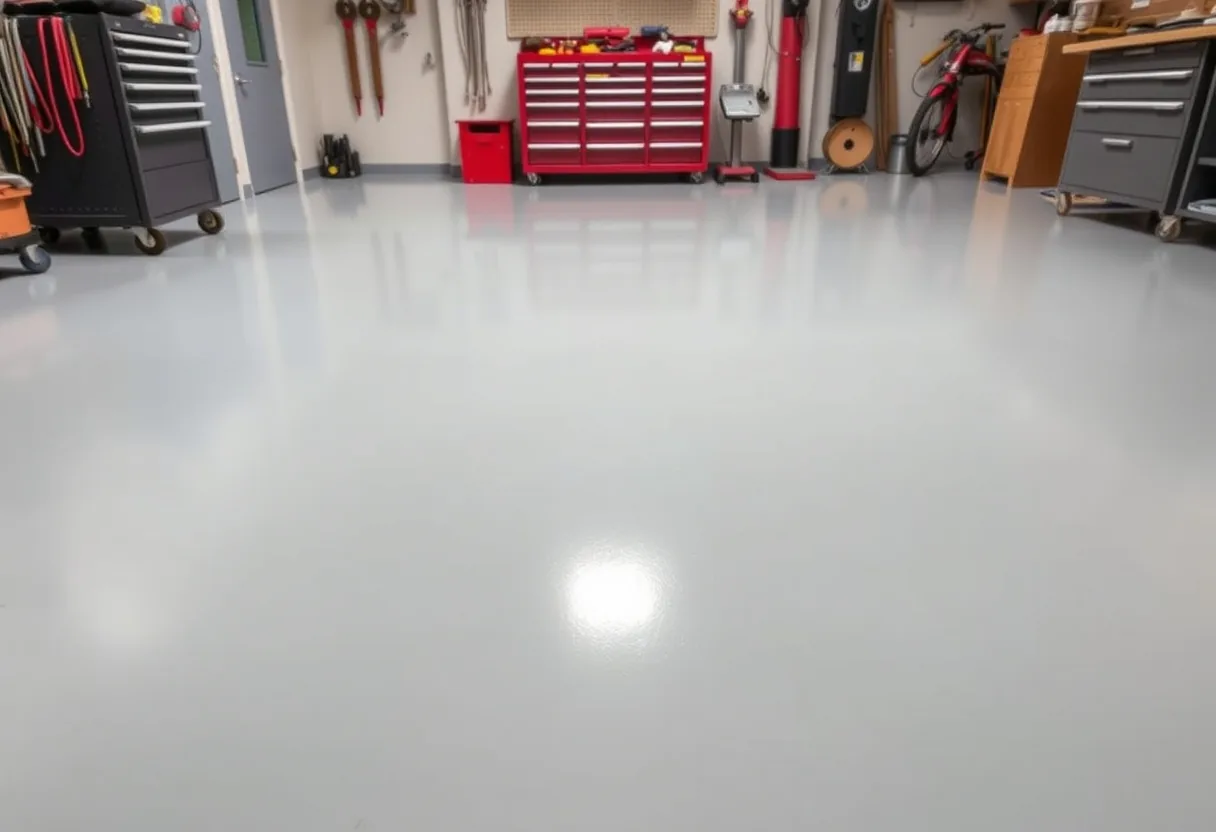
Epoxy is a thermoset resin — a two-part system of resin and hardener that chemically reacts and cures into a hard, rigid film bonded to your concrete. Unlike a thin paint that sits on the surface, a properly installed epoxy floor is a build coat: it lays down thick, fills minor surface texture, and creates a seamless, cleanable layer that stands up to foot traffic, tools, and rolling loads.
That thickness is epoxy's signature strength. A single epoxy application can go down at 10 to 20+ mils — several times thicker than one coat of most topcoats — which is why it has been the workhorse basecoat of the floor coating world for decades. It builds body, hides small imperfections, and gives the finished system something substantial to protect the slab with, usually at a lower material cost than high-end alternatives.
Think of epoxy as the foundation layer of a floor system, not always the whole answer. In many Louisiana installs it is the build coat we grind into the concrete, then protect with a tougher, UV-stable topcoat. Understanding what epoxy does well — and where it struggles — is how you get a floor that still looks right in five years instead of two.
The Main Types of Epoxy Systems
"Epoxy floor" is really a family of systems, each built for a different look and workload. The right one depends on the space, the traffic, and the finish you want:
- Solid color epoxy — a clean, single-color build coat; the economical choice for basements, utility rooms, and simple shop floors
- Flake (chip) epoxy — vinyl color flakes broadcast into the wet epoxy for a decorative, slip-hiding, garage-favorite finish
- Quartz-broadcast epoxy — colored quartz aggregate broadcast for a thick, aggressive-traction industrial surface built for wet or heavy-duty areas
- Self-leveling epoxy — flows out to smooth and level a worn or uneven slab into a seamless flat plane
- Epoxy mortar — the thickest, most impact-resistant build, used to rebuild damaged concrete and take real abuse in industrial settings
The best-of-both approach we recommend most
For a lot of Louisiana floors, the smartest system is an epoxy build coat with a [polyaspartic topcoat](/services/polyaspartic-coatings/). Epoxy gives you the thick, economical body underneath; the polyaspartic gives you UV stability, chemical resistance, and a fast, tough finish on top. You get epoxy's thickness and cost advantage without leaving epoxy's weak spots exposed.
The Honest Tradeoffs of Epoxy in Louisiana
We install a lot of epoxy — but we will always tell you where it falls short, because Louisiana's climate presses on every one of its weak points. Pretending otherwise is how contractors leave you with a peeling floor. Here are the real limitations:
- UV yellowing (ambering) — standard epoxy is not UV-stable; in sunlight or near big garage doors it can amber and dull over time, which is why a UV-stable topcoat matters
- More brittle — epoxy cures rigid, so it is less flexible and more prone to chipping under sharp impact or slab movement than a polyaspartic or polyurea
- Moisture-sensitive during cure — this is the big one in Louisiana; epoxy needs a dry slab to bond and cure, and our humid air and high water tables work against it
- Longer cure time — a full epoxy system often needs multiple days and multiple coats before it is ready for vehicles or heavy use
That moisture point is not theoretical here. On humid, flood-prone Louisiana slabs, water vapor pushing up through the concrete is a constant. If a floor is installed over a damp slab or with rushed prep, that vapor gets trapped under the rigid epoxy film and forces it loose — showing up as bubbling, blistering, and peeling weeks or months later. It is the single most common reason a cheap epoxy job fails in our state.
This is exactly why we diamond grind and test slab moisture before we coat anything, and why on high-moisture slabs we often steer clients toward a polyaspartic system or a dedicated moisture mitigation primer. The coating is only as good as the slab it is bonded to.
When Epoxy Is Genuinely the Right Call
None of that means epoxy is a bad product — it means epoxy has to be matched to the right job. There are plenty of Louisiana floors where epoxy is the smart, cost-effective answer:
- Thick build coats — when you need real body to fill and level a rough slab, epoxy builds thickness that thin coatings simply cannot
- Budget-driven projects — when cost is the deciding factor, an epoxy system delivers a durable, sealed floor for less up front
- [Commercial and warehouse floors](/services/commercial-warehouse-floors/) — large indoor areas out of direct sun, where thickness and price per square foot matter more than UV stability
- Industrial and quartz systems — plants, kitchens, and wash areas where an aggressive quartz-broadcast surface is exactly the right tool
The common thread: epoxy shines indoors, out of direct sunlight, on a slab we have properly ground and moisture-tested. Put it there — especially as a build coat under a protective topcoat — and it earns its long reputation. The wrong place for it is a sun-baked slab with no topcoat and no moisture check.
Epoxy vs Polyaspartic: A Straight Comparison
The question we hear most is epoxy versus polyaspartic (a close cousin of polyurea). Neither wins outright — they trade strengths. Here is how they stack up on the factors that actually decide a Louisiana floor:
| Factor | Epoxy | Polyaspartic |
|---|---|---|
| Cure time | Slow — multi-day, multiple coats | Fast — often one-day return to service |
| UV stability | Poor — can amber and yellow | Excellent — stays clear and colorfast |
| Moisture tolerance | Low — sensitive during cure | Higher — more forgiving on damp slabs |
| Thickness / build | High — great build coat | Thinner per coat — often used as topcoat |
| Cost | Lower material cost | Higher, but faster labor offsets it |
| Best use | Indoor build coats, budget, warehouse | Garages, sun exposure, one-day jobs |
Read that table and the winning move is usually obvious: use both. Epoxy as the thick, economical build coat, polyaspartic as the UV-stable protective topcoat. For a deeper breakdown with local pricing, see our polyurea vs epoxy cost guide.
Why Prep Decides Everything
You can buy the best epoxy on the market and still watch it fail if the prep is wrong. Surface preparation is the difference between a coating that bonds for a decade and one that peels in a season — and it is where the cheap quotes cut corners.
We prep every floor with diamond grinding, not acid etching. Grinding mechanically opens the concrete to a consistent profile the epoxy can lock into. Acid etching is the shortcut too many low-bid installers rely on — it is inconsistent, leaves residue, and is a leading cause of delamination on Louisiana slabs. We do not use it.
- Diamond grinding to a proper concrete surface profile for a true mechanical bond
- Slab moisture testing so we know what we are coating over before we commit
- Crack and spall repair to fill and rebuild damaged concrete before the build coat goes down
- Full cleanup and vacuum so no dust or contaminant gets trapped under the epoxy
If your slab needs it, we handle repairs and vapor issues up front through our concrete repair and moisture mitigation service. Prep is not the boring part of the job — it is the job.
Cost, Warranty, and Getting a Real Quote
Honest pricing starts with honest expectations. Epoxy build coats are often the most economical way to get a durable, sealed floor, which is a big part of their appeal. But the real number depends on your slab's condition, the system you choose, and how much repair and moisture work the concrete needs before anything gets coated — every quote below is a general estimate, not a promise.
A straightforward indoor epoxy floor typically lands in a lower price band than a full polyaspartic or polyurea system, especially over a slab in good shape. Add flake or quartz, extensive crack repair, or moisture mitigation and the cost rises with the scope. We would rather quote you the honest number than win the job with a lowball that skips the prep your floor needs.
Backed by a real warranty
Because we grind, test, and prep every slab correctly, we stand behind our epoxy systems with a genuine warranty — real protection, not a handshake. A properly prepped and topcoated epoxy floor is built to serve for years, and we put that in writing.
Want to know what your specific floor should cost and which system fits it? Get a [free quote](/quote/) or call us at 844-967-5247. We will look at your slab, talk through epoxy versus polyaspartic honestly, and recommend the system that actually makes sense for your space — not just the one that is easiest to sell.