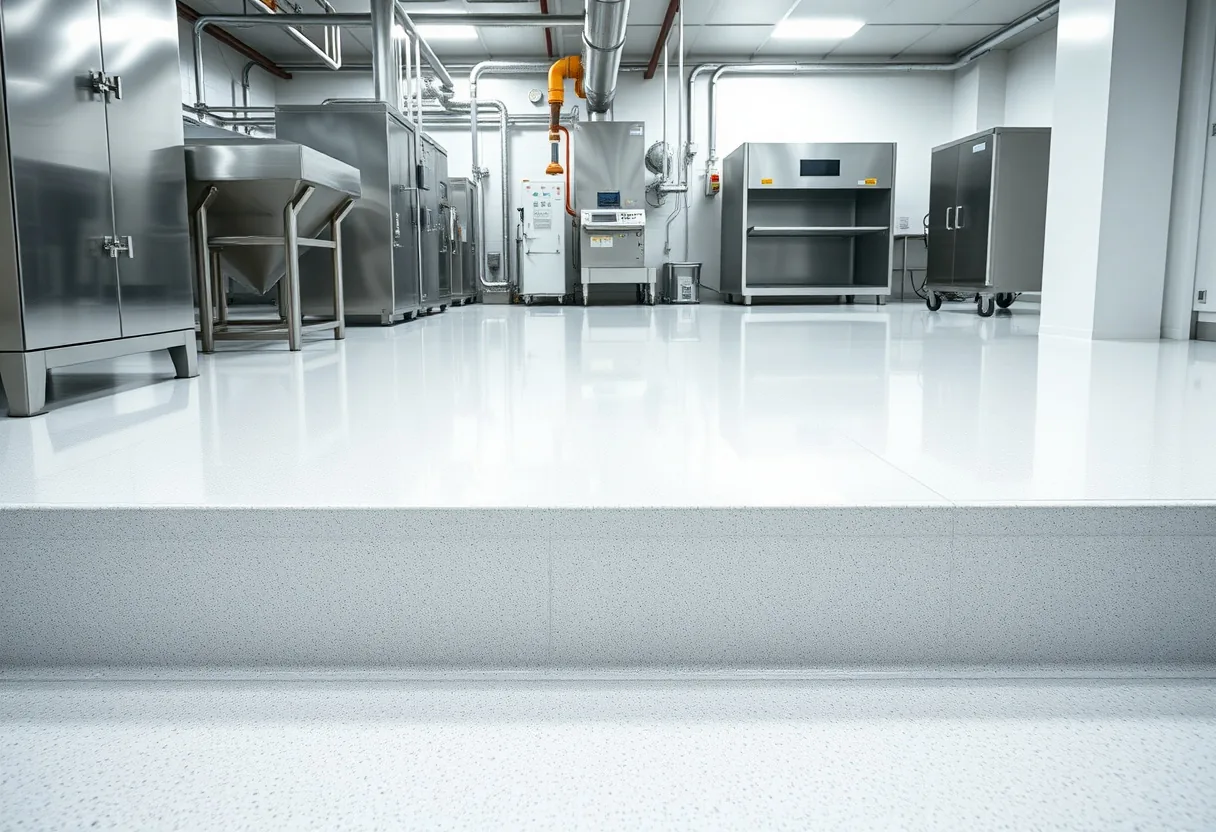
Heavy-Duty Systems Built for Food Plants and Industrial Floors
A food-processing floor is one of the harshest environments in any building. It gets blasted with hot washdown water, scrubbed with caustic sanitizers, hit with dropped tools and pallet jacks, and never truly dries out. Standard epoxy chips, delaminates, and grows bacteria in the cracks. We install heavy-duty systems engineered specifically for wet-process and industrial abuse — matched to your plant, not pulled off a shelf.
- Urethane cement / mortar — the workhorse for wet-process and washdown areas, handling thermal shock when hot water hits a cold slab
- Antimicrobial coatings — additives that resist bacterial and fungal growth on the finished surface
- Chemical-resistant novolac epoxy — for acid, solvent, and aggressive-chemical exposure in processing and lab zones
- Quartz broadcast systems — decorative and slip-resistant, built up for impact and abrasion resistance
- Polyaspartic topcoats — fast-curing seal coats that get a line back into service in about a day
Every sanitary install includes integral cove base — a curved, seamless transition where the floor meets the wall. There is no 90-degree crack for water, debris, or bacteria to hide in, and a squeegee or hose cleans right up the cove. It is the single detail that separates a real food-safe floor from a coated slab.
Compliance: Seamless, Non-Porous, and Inspection-Ready
USDA, FDA, and HACCP programs do not certify a specific brand of coating — they demand outcomes. Surfaces must be cleanable, non-absorbent, and free of harborage points where bacteria can colonize. A properly installed seamless, non-porous floor delivers exactly that, and it is far easier to defend during an audit than tile grout lines or bare concrete.
- Seamless and monolithic — no grout joints, no tile edges, nothing for product residue to lodge in
- Non-porous surface — liquids and organics sit on top and rinse away instead of soaking in
- Slip-resistant textures — aggregate broadcast tuned for wet, greasy, or freezer conditions to protect your crew
- Easy sanitation — smooth, coved surfaces stand up to daily caustic and hot-water washdown cycles
- Antimicrobial option — an added layer of protection for high-risk production and packaging rooms
Harborage is the fail point
Most floor-related sanitation write-ups come from harborage — cracks, hollow spots, and failed joints where moisture and organics collect. A monolithic urethane cement floor with coved base removes those hiding places, which is why processors reach for these systems ahead of an audit rather than after a citation.
Louisiana Industries We Coat
Louisiana's economy runs on plants that punish their floors. We work across the state and up and down the Gulf Coast, matching the system to the process happening on top of it.
- Seafood and food processing — shrimp, crawfish, and packing plants with constant water, salt, and cold
- Breweries and distilleries — sugar, yeast, acids, and standing water on production and bottling floors
- Commercial kitchens — grease, hot oil, and heavy foot traffic in restaurants, hotels, and institutions
- Cold storage and freezers — floors that must survive freeze-thaw cycling and sub-zero service
- Chemical and petrochemical — refinery, plant, and lab spaces needing aggressive chemical resistance
- Pharmaceutical and manufacturing — clean, controlled, low-shed surfaces along the industrial corridor
If your process does not fit neatly into one of these buckets, that is normal — most plants blend wet zones, dry storage, and traffic lanes under one roof. We zone the building and spec a different system for each area rather than forcing one product everywhere.
Why an Industrial Floor Has To Survive Louisiana
The reason plant floors fail is rarely one thing — it is the stack of stresses hitting the same slab at once. A coating that shrugs off chemicals but cannot take heat, or handles heat but not forklift loads, will still peel. We select systems for the full load case your floor actually sees.
- Thermal shock — hot washdown or cook water on a cold slab expands the surface and rips weak coatings loose
- Harsh chemicals — caustics, acids, sanitizers, blood, and fats that dissolve or soften ordinary epoxy
- Constant moisture — water that never fully leaves a wet-process room and drives coatings off from underneath
- Forklift and equipment loads — point loads, turning wheels, and dropped impact that crack thin films
- Freeze-thaw — cold-storage and freezer floors that cycle through expansion and contraction daily
Urethane cement earns its place here because it expands and contracts at nearly the same rate as concrete. When 180-degree water hits a 40-degree slab, the floor and the coating move together instead of tearing apart — the failure mode that ends most epoxy floors in a washdown plant.
The Louisiana Angle: Humidity, Moisture, and Storm Recovery
Louisiana is one of the toughest coating climates in the country. Extreme humidity and heavy washdown mean moisture is constantly trying to push up through the slab as vapor. Coat over that without addressing it and you get bubbling, blisters, and delamination within months — no matter how good the topcoat is.
The fix is vapor-tolerant systems paired with proper [concrete repair & moisture mitigation](/services/concrete-repair-moisture-mitigation/). We test slab moisture, install mitigation where readings demand it, and choose urethane cement chemistries that breathe rather than trap vapor. Skipping this step is the most common reason a plant floor fails early — so we never skip it.
Built for hurricane country
Gulf Coast facilities cannot afford long shutdowns, so we plan for fast return-to-service and phased installs that keep part of the plant running. After flooding, we also handle re-coats — grinding out damaged material, correcting moisture, and rebuilding the floor so you reopen clean and inspection-ready.
Choosing the Right System
There is no single best floor — there is the right floor for a given room. The table below is how we frame the core trade-offs between the three systems we specify most in Louisiana plants. On a walkthrough we match each zone of your building to the system that fits its heat, chemicals, and traffic.
| System | Best use | Chemical / thermal resistance | Relative cost |
|---|---|---|---|
| Urethane cement / mortar | Wet-process, washdown, cook, and freezer floors | Excellent chemical; excellent thermal shock and heat | $$$ (highest) |
| Novolac epoxy | Aggressive acid and solvent exposure, lab and process zones | Excellent chemical; moderate thermal | $$ (mid) |
| Polyaspartic topcoat | Fast seal coats, dry production, traffic lanes | Good chemical; moderate thermal, fast cure | $$ (mid, fast-return) |
In practice these get combined — a urethane cement mortar body in the wet room, a novolac layer where a specific acid is present, and a polyaspartic seal that lets you reopen fast. Compare this against our standard [epoxy floor coatings](/services/epoxy-floor-coatings/) and heavier [commercial & warehouse floors](/services/commercial-warehouse-floors/) to see where each fits your building.
Downtime Planning and Food-Safety Coordination
In a working plant, the floor is never the only priority — production is. We plan every industrial install around keeping your operation moving, which means the schedule matters as much as the coating. Fast-cure systems and night or weekend work are tools we use to shrink your downtime.
- Phased installs — we zone the plant and coat section by section so unaffected lines keep running
- Food-safety shutdown coordination — we sync with your sanitation, QA, and production teams around wash-down and inspection windows
- Fast return-to-service — polyaspartic and fast-set urethane options get key areas back online in roughly 24 hours
- Clean containment — dust control and barriers keep grinding and prep out of active production space
Before anything starts, we walk the facility with your team and build a written sequence: which rooms, in what order, on which shifts, with what cure times. You know exactly when each zone goes down and comes back — no surprises, no unplanned line stoppages.
Cost, Warranty, and Getting a Quote
Industrial and food-processing floors are specified by the room, so pricing ranges with the system and the prep required. As a planning guide, heavy-duty installs typically run $7 to $15+ per square foot — urethane cement mortar with cove base sits at the top of that range, while polyaspartic seal coats and lighter novolac builds come in lower. Slab repair and [moisture mitigation](/services/concrete-repair-moisture-mitigation/), when readings call for it, are quoted separately so nothing is hidden.
Every system we install is backed by a written warranty — up to 15 years on properly specified industrial floors — covering adhesion and material performance under normal plant service. That warranty is only as good as the prep behind it, which is why we test moisture and profile the slab before a single coat goes down.
Ready to price your plant? Get a [free quote](/quote/) and we will schedule a walkthrough, or call 844-967-5247 to talk through your process, your washdown routine, and your production schedule. We will tell you honestly which system your floor needs — and which zones can run a lighter, less expensive build.